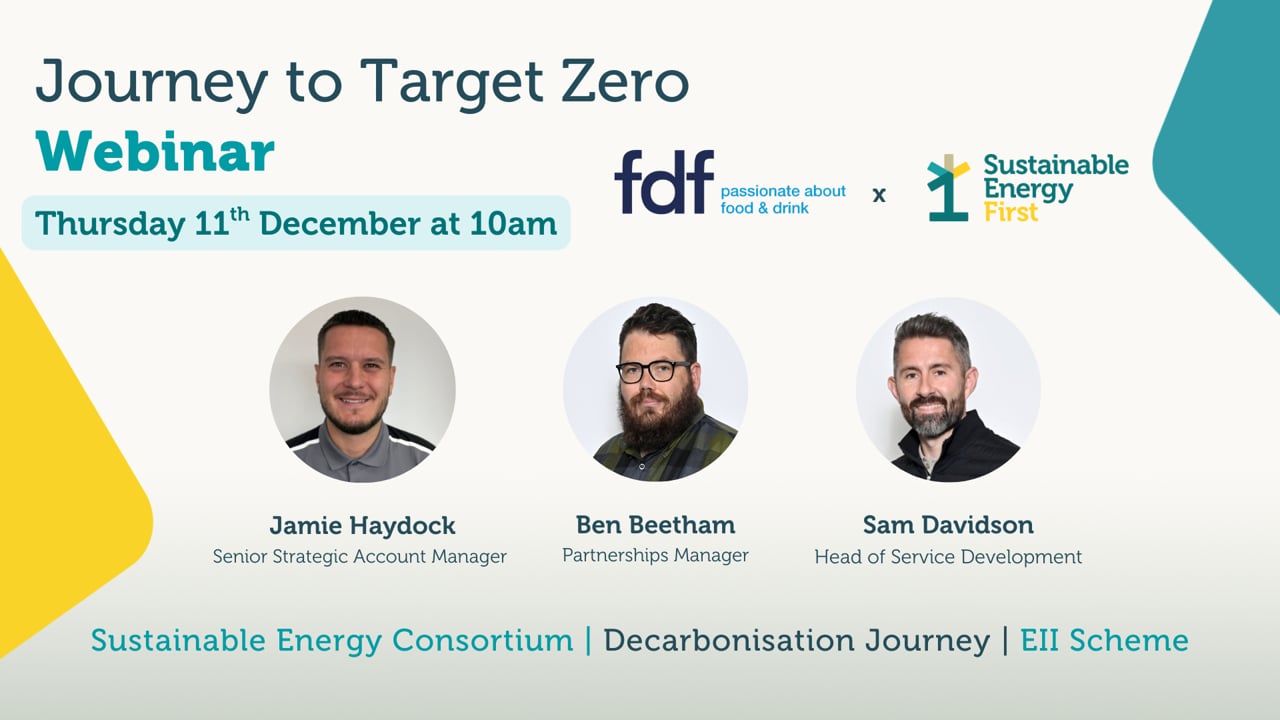
First of all, thank you to everyone for coming today. We hope that you found the content useful.
0:12
There will be a Q &A at the end, so please put any questions that you have into the questions box, and we'll do our best to go through as many as we can at the end of the webinar.
0:20
Following the webinar, we'll be sending you an article email in the next couple of working days, and this will contain a recording of the presenters.
0:30
So, without any further ado, I'll hand you over to Ben Beatham.
0:34
Hello, everyone.
0:36
So, yeah, I'm Ben Beatham.
0:37
I look after the partnerships here at Sustainable Energy First.
0:41
Looking forward to presenting to you all today.
0:44
We're working now with the Food and Drink Federation to promote sustainability.
0:49
So our webinar today, I'm bringing with me Jamie Haydock and Sam Davidson.
0:55
I'll let them introduce themselves properly on their parts of the webinar, but we're going be discussing the Sustainable Energy Consortium, your decarbonisation journey and the EI scheme.
1:08
Like Luke said, if you've got any questions, please get them in the section and we'll answer them at the end. So let's begin.
1:17
So to give you a bit of a high-level look at our company and our capabilities, I've put this slide together for you.
1:24
So we've now got 83 years combined history between the two companies.
1:32
So I'll go into that in a bit more detail.
1:34
There's now 470 of us within the company.
1:38
I think the most impressive stats that we've got is that there's 8 billion pounds worth of energy under the management.
1:46
We're invoicing 3 million invoices per year and it's working out at 11% of commercial energy is now managed by us.
1:54
We are the largest privately-owned energy and sustainability specialist within the UK.
2:04
So a bit of background on Sustainable Energy First.
2:09
We were founded by two founders in 1997 as B.I.U. The journey and the growth has been phenomenal since then.
2:19
A few milestones that I'd to mention would be 2017. We had the senior management team change.
2:27
Since then, in 2022, we rebranded as Sustainable Energy first.
2:34
Then, in 2023, we achieved B Corp status, which we're extremely proud of.
2:41
As you can see now, we did acquire a company called Enco, which enabled us to do a lot more and now there's 470 of us in house.
2:53
So what do we actually do?
2:55
I'm not going to steal Sam and Jamie's fund by talking about what we do too much because that's what they're going to be doing but as a brief outline there's some of the services that we do offer.
3:07
Revenue recovery is retrieving, looking back over six years worth of gas, electricity and water and see if we can reclaim any revenue on what you've done. We've got a team of renewable energy experts in house.
3:20
Utility management is extremely important for companies that have a number of sites.
3:26
Sustainability in the purchasing products, Jamie is going to highlight a bit more.
3:31
Site infrastructure, like I said, I don't want to go on too much about these products because that's what Sam and Jamie are here to do.
3:40
Again, just to add to our credibility, I'm not going to sit here and list them all off.
3:45
So I'll leave the screen up there for a moment for you to have a look at.
3:48
In your industry, there's certainly a lot of companies in the food and drink industry.
3:55
So that just shows the credibility and the type of customers that we look after to know that you're in safe hands with us.
4:03
So Luke, if you'd like to, I'll move on to the next slide, but if you'd like to hand over to Sam, we'll let him take his part.
4:38
I'm Sam Davidson, I'm the Head of Citizens Development.
4:41
Thanks for joining us all this morning.
4:43
I've spent the last 15 years of my career in a variety of roles, really trying to reduce the friction for organisations to reduce their cost of carbon.
4:52
My presentation today is going to be about the forces really compelling organisations such as yours, to act on sustainability amid the growing environmental and economic volatility.
5:02
Sustainability, and this is really kind of the crux of my presentation, is really about finding the balance between people, planet, and profit.
5:10
But the volatility of those factors, however, can make taking meaningful action hard to navigate, especially in the face of an escalated climate crisis.
5:18
So organizations such as ours exist to try and reduce that friction and make that easier for you to operate.
5:27
So I'm going to start with unpacking the people and planet elements.
5:31
I'm going to frame each of the elements, people, planet, and profit, in terms of exposure to risk, but also the opportunity potential available.
5:40
So it's not going to be a history lesson, if you're pleased to hear, but I'm going to start at the Industrial Revolution.
5:45
So since the 1850s, since the Industrial Revolution, the planet has warmed by 1.2 degrees.
5:51
And if we look at the impact that that's had over the last 100 years, since the 1920s, we can see that it's got worse and unfortunately it's getting worse faster than ever before.
6:04
So just sticking around the UK for now, so sea levels have risen by 20 centimetres since 1900s, the number of reported flood events increased fivefold, there are actually 50 in the last five years and they're only 10 in the 30-year period, 1920 to 1950.
6:23
And if you look at the properties now at risk of flooding within the United Kingdom, they stand at 26%, so 6.3 million properties in the UK are currently at risk of flooding.
6:33
But it's not just got wetter, it's got a lot hotter too.
6:36
So expanding our gaze now geographically to UK and Europe.
6:41
The number of major wildfire areas lost to wildfires has increased tenfold.
6:46
So we lost about a million hectares of land to wildfires over the last five years.
6:53
And if we look at the number of heatwaves, there was actually 12 in the period 2020 to 2025, but they were unheard of towards the turn of the century.
7:03
There was actually only one during the period 1920 to There are actually four over the last year, and a heat wave is classified as temperatures being sustained for 25 to 28 degrees for more than three days.
7:17
And finally, as you'd expect, the number of record-breaking hot days has increased by 15 times.
7:27
So things are getting worse, but things are accelerating.
7:31
Things are getting worse at an accelerated pace, and this acceleration has really happened since the 1980s.
7:36
The IPCC, the Intergovernmental Panel on Climate Change, believes that actually our best case scenario is that we can expect a 1.5 degree warming by 2100, but it's a very likely scenario that actually we're in for a 3 degree warming.
7:50
So we only have to extrapolate those blue and red and yellow lines to think about what our lives are going to be like in the near term, in the next 10 to 30 years.
8:01
And the UK food consumption industry, so the FDF, has got a significant role to play.
8:05
So you'll all be sure aware that this sector actually contributes 20% per UK emissions.
8:12
So FDF members will be key drivers of change, but also your future earnings are reliant on that change handling.
8:20
But it's not all doom and gloom, you'll be pleased to hear.
8:23
So I'm gonna compare the FTSE 100 versus the FTSE for Good.
8:28
So lots of you will be familiar with the FTSE 100.
8:31
The FTSE for Good index, however, is made up of companies that exhibit strong ESG commitments.
8:37
And comparing the two tells a compelling story about how organizations which really embed sustainability in their organizations stand to gain from an economic point of view as well.
8:48
So I'm going to compare the average day trading price of the FTSE 100 versus the FTSE for good. I'm going to overlay two events.
8:57
So the first one being the 2008 financial crisis. So both indices took around about five years to recover.
9:03
And I'm also going to overlay the 2020 COVID lockdown.
9:07
And what we can see here is that the two indices behave very, very differently.
9:11
So the FTSE procured, dipped initially, but then only took five months to recover.
9:16
But then it went on a month-on-month record high for the next two years.
9:20
Over that same two-year period, the FTSE 100 took that full two years just to recover to its pre-COVID value.
9:29
So why did this happen?
9:30
Well, COVID didn't just change all our lives, also changed the way investors look at organizations and it's because the market recognized that ESG-aligned companies are more resilient, they're less dependent on fossil fuels and travel and they manage risk more effectively.
9:44
So as I say, COVID didn't just disrupt all our lives and so we defined what investors value in a company.
9:52
So bringing all that together and towards what today's really about in terms of a pathway to target zero.
9:59
We can think of this as like balancing an equation.
10:02
So, on the one hand, the challenge is you've got the cost of doing something but also the cost of not doing anything at all.
10:09
You've also got your carbon emissions, which particularly for this sector, for the FDA, present a risk when we think about rising temperatures and greater numbers of flood events and how those events add to the vulnerability of food and drink supply chain. And then there's the compliance element.
10:24
Now, we deal with the energy and carbon legislation such as SECA and ESOS and CCAs and UKATS and people on this call will need to comply with a patchwork of those.
10:34
But when I was doing research for this presentation, I counted at least five, and I'm sure there's more, but at least five waste and packaging regulations.
10:42
There's various water environmental regulations.
10:44
And on the horizon, we've got ESG, various types of ESG disclosures coming in.
10:50
So cost, carbon and compliance are really a major challenge facing this industry. And the objective is the balance of this people, planet and profit.
11:04
So a cost efficient business, emissions reduced as much as possible, compliant and obviously competitive.
11:11
And what we tried to do, and again there's no silver bullet, but as a doing consultancy we have more than just compliant support with environmental and carbon regulations.
11:21
We want to provide you with a real pathway to meeting that balance.
11:24
So we come up with a service called the Target Zero Partnership.
11:28
So, Target Zero Partnership upgrades the simple payback ESOS audits that some of you will be familiar with.
11:34
And it upgrades these to investment grade audits utilizing our in-house engineering team.
11:39
And these audits create therefore bankable projects that you can actually sign off because you've got the tangible, understanding all the costs, understanding all the savings.
11:48
And we create an implementation impact roadmap with you drawing upon all our expertise and drawing on our approved technology partner network that we've curated over time, which we can advise you on on how to select the right partner.
12:00
And we do that heavy lift so that you don't have to, so you don't have to go to market to find or screen 20 solar partners and 30 lighting partners and X number of BMS control partners, et cetera, et cetera.
12:13
But we don't stop there, so what we also do is we will project manage the rollout of those projects according to the roadmap which we've developed with you.
12:20
and then we also verify all the savings of each of the capital projects and to remove even more barriers we can offer this as both capex solution if you wish to pay for it yourself but we can also offer it in a fully financed way for both the capital project elements and also the consultancy service elements.
12:38
So conceptually hopefully that all sounds great but actually we want to show you this in practice so my final slide is really an invitation to you all before I pass to Jamie We'd like an opportunity to really show you this in real life.
12:51
So building on the success of an event we held in Manchester, our first, our inaugural Pathway to Target Zero event, our next event is going to be on April 22nd on Earth Day at Motel Studios in Shoreditch.
13:03
So we're taking the event on the road to London and there you'll be able to see in real terms and the full supply chain to get you to Target Zero, whether that's Target Zero cost, Target Zero emissions.
13:16
emissions.
13:17
We'll have firesides, we'll have panel discussions, we'll have an exhibition of some of our technology partners and you'll also be able to speak to experts such as Jamie about our green offering and our revenue recovery products etc etc.
13:33
So I'm going to now pass to Jamie who is going to present on the Sustainable Energy Consortium which is a great way to start on your journey to and thanks.
13:47
Thank you very much Sam, thank you and thank you Ben for the introduction. Just check I've been given, yeah brilliant.
13:56
So yeah so Sustainable Energy First, we've existed in the market as Ben said for a number of years now and my name is Jamie Haydock, I'm a senior strategic account manager within SE First.
14:07
I've worked with the business now just coming up to seven years and I've within energy, pretty much man and boy.
14:14
I've done nearly 15 years and I've worked both on the supply side of the sector and now the consultancy space for the last 10 years or so.
14:24
My role within SE First is I predominantly manage our key INC clients and I constantly have conversations with them about things linked to sustainability and a more greener of buying their energy contracts alongside other things as well.
14:42
There's two areas I'm going to talk to you predominantly about today.
14:48
Firstly is our unique product, which is our sustainable energy consortium, and then I'm going to talk a little bit about our revenue recovery service, some of the success we've had in the last 12 months in relation to that area.
15:00
And one of the reasons why we sort of partnered with the FDF was to look at things like schemes, which we've done successfully for some of their members over the last couple of years as well.
15:24
So starting with our sustainable energy consortium then.
15:26
So within our procurement team and our risk management team, we offer an innovative and unique supply product called our Sustainable Energy Consortium.
15:37
So our Sustainable Energy Consortium we developed over the last five years and have successfully rolled this out over the last two.
15:44
And this has brought to the market the ability for end users via ourselves to buy deep green renewable energy from specific energy generation assets.
15:56
Now, this sort of the green approach within the market for end users typically has been things like buying regos, which in the last couple of years we've seen some volatility there and obviously there's a premium on top of your commodity price or your energy contract to do that.
16:15
And for sort of bigger consumers of electricity, things like corporate PPAs which come with sort of added complexities, legal costs and significant restrictions.
16:25
So we actually identified that there is a requirement for a product to reach out to a wider audience.
16:33
So we worked very hard with generators, energy suppliers, and our customers to develop what is the Sustainable Energy Consortium.
16:41
Now, this consortium, as I said, it's true green.
16:45
It gives you fully traceable electricity supply.
16:48
But it also comes with cost benefits as well, which I like to sort of say, this is a true sustainable product that actually encompasses some elements of cost savings along the way and along the sort of journey whilst you're in this product as well.
17:04
Something which I think sustainability is always seen as come as a bit of a cost to sort of green up or do things that fit for your business as well.
17:12
So I'll sort of take you on a bit of a journey in the moment in terms of how we brought this together and where we are today.
17:18
and I'll talk about some of those cost savings along the way as well.
17:24
So I mentioned there, firstly, you've got, sorry, one second.
17:28
Just waiting for my move to the next slide. There we go.
17:40
So right at the start of this sort of going back five, seven years, when we sat down as a business and we looked at how we could bring something like this to the market.
17:50
One of the things that we did have was we have really good generator relationships.
17:54
So we have a renewables team with consists of five people within SE First, and they specifically manage our generator relationships and look at what we can do in terms of supporting clients there.
18:07
So we were on a journey with some of our clients in relation to corporate PPAs, and naturally we were having conversations with generators about things like our sustainable energy consortium.
18:18
And what we did was the first thing was we went and contracted energy from a number of different assets that you can see here on screen to be sleeved into our energy consortium.
18:28
Naturally generators, they like energy consultants like ourselves.
18:33
We have eight billion pounds under energy management as was mentioned earlier, and we have a really good customer base to sort of bring to the table.
18:41
So first things first, we went and secured generation.
18:44
Now this was from a number of different assets that you can see here on screen.
18:47
And this is where the traceable element of the sustainable energy consortium comes in.
18:52
Each customer within our consortium gets a quarterly or annual benefit statement, showing them exactly where their electricity has come from and what specific asset that has been from and the type of technology as well.
19:05
So that was sort of the starting point and that laid the foundations for us to then go and have further conversations with an energy supplier.
19:15
So we partnered with Evolve Energy.
19:18
Evolve Energy are a forward thinking, renewable-friendly, PPA-friendly electricity supplier.
19:25
And we worked with them very closely to essentially tie this together.
19:30
So we have the customer base, we have the generation, but you need a licensed energy supplier to bring all this together.
19:36
So again, we sat down with them and we developed this concept and they happily partnered with us.
19:42
And traditionally at the moment, their partnership is to run for the next five years and they will be the licensed energy supplier supporting this and are currently the licensed energy supplier supporting this.
19:53
They support us with the matching of volume, which I'll come onto in a moment, which generates some savings for our customers on non-commodity relief.
20:00
And they also support us with our benefit statements and the traceable electricity supply as well.
20:07
So first part of the generation, that was ticked.
20:11
We then partnered with an energy supplier and contracted with the licensed energy supplier to bring this together.
20:17
So, what that then meant was for our customers, we could provide them with full traceable electricity, we could provide them with price security over a longer term, not as long as traditionally a lot of corporate PPA or PPAs within the market were though, which traditionally are 10, 15 or 20 years, this is over a shorter term, and it gives them 100% traceable energy supply.
20:40
Now also, this gives our customers the ability to then make cost savings along the way during the life of this product.
20:53
Sorry, I'm just waiting for the next slide to come on.
20:58
So the strategy itself, and when we talk about cost savings, it is NCR enabled.
21:05
So that is non-commodity relief.
21:08
So every single member of our sustainable energy consortium has the ability as part of this to achieve roughly one and a half to two pence of a removal on some of the non-commodity charges.
21:21
Now, how this is possible and how this is possible on this concept and no other traditional electricity contracts where you buy regos, for example, is we match the volume of all of the clients and specific clients within our portfolio against the renewable generation.
21:39
Now, once that's matched and is a successful match, that is CLASTA's Class A license exempt supply.
21:45
And we are then able to remove some of the renewable energy taxes that exist on your bill.
21:51
So on an end users bill, traditionally you have the commodity and then all of the non-commodity charges.
21:56
Now within the non-commodity charges, you have a number of different renewable energy taxes within there, such as renewable obligations, feeding tariff charge, the capacity market charge and contracts for difference.
22:08
Now over the last sort of five, seven years in partnership with some energy suppliers, we lobbied that Class A license exemptions should be passed.
22:18
Now the reason why that is is why should an end user that's buying their electricity and it's fully traceable to a specific renewable energy asset therefore pay some of the renewable energy taxes that are on your bill to support renewable generation, because ultimately, as an off-taker and being part of this, you're already funding renewable generation going into the grid by being an off-taker of one of these projects and being a part of the sustainable energy consortium.
22:45
So class A license exemption was passed, and that's been a thing within the industry now for a fair few years, and we, as part of this concept, have brought this to this product.
22:57
So we do all of the matching for you.
22:59
we match all of your volume on a half hourly basis against the demand, and annually or quarterly, you get a reconciliation of these charges on your electricity bill.
23:09
As I say, this is a real game changer for a product like this because it brings into the equation a cost saving that cannot be achieved through a traditional electricity supply contract or by simply just greening up through buying regos.
23:25
So that was a big thing that we've pushed when having conversations with our customers on these products is this is a true concept and is something that is very much live as part of this as well.
23:37
And you get a benefit statement and an annual reconciliation or a quarter reconciliation detailing exactly what you save on an ongoing basis as well as part of this.
23:48
So the commodity aspect.
23:50
Now, I essentially like to summarize this product as it's simpler than flex, but smarter than fixed.
23:59
So flexible energy procurement and long-term risk management is something we've done forever and a day.
24:03
And as we've seen sort of during the energy crisis, there is volatility and there is risk associated with traditionally buying a flexible supply contract.
24:13
Likewise, there is also risk when buying a fixed price contract.
24:17
Now, what we've done with the commodity aspect for the Sustainable Energy Consortium is as you can see here over the last couple of years we were at a point in time when this rolled out where the market was at sort of the prevailing rate you see at the start of the slide here and then in the time the commodity price of the sustainable energy consortium has fallen obviously as the market has come down.
24:40
Now there's two reasons why that's possible and this is where the performance reward opportunity comes in as part of the commodity aspect is we are constantly securing generation for the Sustainable Energy Consortium.
24:53
So whilst we have about 300 gig of volume secured, we're constantly looking at securing more and more generations to be sleeved into our Sustainable Energy Consortium.
25:03
Now, as we're doing that and as we're securing generation at the prevailing market rate, and hopefully that is lower, that is then being passed on to all of the members of the Sustainable Energy Consortium.
25:16
Now, as we've been in a falling market, we've seen them opportunities open up considerably and we've been securing generation year on year at a point in time that's coming down.
25:27
So our businesses within this consortium are significantly benefiting from the commodity aspect coming down.
25:34
It can go up and it won't go up so they're always fully protected at a point in time, but they have the ability to improve the position once we secure generation that's leading at a cheaper price.
25:44
Now, just sort of to cover any benefits of Dow, if the market rebounds at a point in time and generation is secured at a higher rate than what is currently being achieved as a sustainable energy consortium, then we open up a new consortium for said clients who have entered at that point in time as well.
26:03
So there is no negative cross-subsidization to this.
26:07
Everybody within the consortium only stands to benefit on the commodity aspect, so it's fully budgeted for, but that can be improved over the life of the consortium as well.
26:18
As you can see on this screen, there's been a significant benefit to those businesses that have been in this from day one on their commodity aspect, as we've been securing more generation at the prevailing market rate.
26:30
As I say, we continue to do this.
26:32
Whilst we see 87 pound a megawatt hour next year, and that's just commodity, that's not even taken into consideration the relief you get and inclusive of regos, You're going to potentially see if we secure volume at a cheaper price for next year and years forward, that just dropping and dropping and dropping.
26:48
So it's a real positive aspect and is where cost savings can be achieved throughout the life of the contract on the commodity from day one as well.
27:03
So over the last two to three years, as we've been sort of moving through the times, we've been slowly converting a lot of our traditional consortium and our fixed price customers to Sustainable Energy Consortium and it's had significant uptake as you can imagine because of the cost savings that can be achieved but also the sustainability benefits in relation to your scope to emissions.
27:27
Now some of these customers on here were bespoke flex customers on their own risk management contract, some as I say were consortium customers, some were fixed.
27:36
There's some very notable names, I mean probably one of the biggest notable names on here is Clifford Jantz, probably one of the biggest war firms in the UK, NCP Carparks, ITSU, they're a significant food retail client of ours, and they were one of the early adopters actually of the Sustainable Energy Consortium back in 2023 when this went live.
27:56
We've got a number of other really well-known names.
27:58
If we've got any football fans on here, we've got the mighty Bolton Wanderers as well.
28:01
I'm not a Bolton fan myself, but they're a football club that have adopted this approach in recent times.
28:07
So it's been very successful, and it's been really successful rollout across our existing customer base and also when we've been talking to potential new customers as well.
28:17
And interestingly across the food and drink federation there is eight customers within there currently and roughly 26 gig of annual consumption within the sustainable energy consortium as well and for a lot of them the key drivers was obviously sustainability and being sort of more green purchasing volume over a longer term that allows them to take advantage of the Scope 2 benefits, but also what we're seeing as well is some of them businesses passing this down to their clients and essentially it's having a positive impact on their Scope 3 as well.
28:50
Any big corporates on this call and that we're talking to that has a significant supply chain.
28:55
For example, as there are a client of mine, we're having conversations with them about how this can positively impact their supply chain and ultimately their Scope 3 emissions as well.
29:05
The Food and Drink Federation, there's a number of customers within there currently that are within the Sustainable Energy Consortium.
29:14
So just to summarise and just to sort of bring all this together it's a hundred percent traceable, the Sustainable Energy Consortium sorry is a hundred percent traceable, green energy and really positive impacts on any net zero ambitions you have as a business.
29:28
You've got cost saving benefits with this through the non-commodity relief and the ability to improve your initial commodity position during the life of the contract as well with obviously an upper limit protection from day one.
29:40
So as I said before, smarter than fixed, simpler than bespoke, but does give a sort of true green, traceable electricity contract and obviously gives you significant benefits to doing that as well.
29:54
Happy to answer any questions at the end on this and likewise, if anybody wants to ask any further questions or have a more one-to-one conversation, myself and the team will be on hand afterwards to have a discussion with you on that.
30:10
So that just sort of ends the sort of Sustainable Energy Consortium presentation in relation to one of our procurement services.
30:18
I just wanted to touch on really quickly some of the work we've done in relation to utility bill auditing and essentially what is known as revenue recovery within the industry.
30:31
We, SE First, have pretty much since our inception had a service that existed around bill auditing, and it's been a very successful service for us.
30:44
The two founders of our business, they would probably actually say that this was the biggest service we provided for a number of years.
30:53
Unfortunately, we sit in an industry where errors occur, errors happen, essentially on the supply side of the industry.
31:02
More so in the last few years because we have seen things like suppliers changing billing systems, the introduction of new non-commodity charges, the removal of certain non-commodity charges, and the changes to certain schemes that have meant that there is changes to the amount of discount you can achieve on things like CCL and some of the renewable energy tax on your bill, which I'll talk about.
31:26
We, SE First, we operate a revenue recovery service.
31:29
The revenue recovery service, it operates under a share of savings.
31:35
So if we run an exercise for any business or we do run an exercise for any business, if we find nothing, there's nothing to pay.
31:42
So there's absolutely no risk to the end user.
31:44
It doesn't interfere with any service contract you've got at the moment.
31:48
It doesn't interfere with any of your supply contracts.
31:50
And even if you have an appointed energy consultant looking at certain things, this doesn't interfere with that either.
31:56
So we review, we analyze, and then hopefully we find, or obviously if we don't, then you've got a sort of clean bill of health on the billing.
32:05
And then we sort of challenge anything that we do find and we come back to you and say, right, okay, there's been X amount overcharges on this bill in 2022.
32:15
We have six years to go back.
32:16
So we do a full six year review of all of the historical charges, all of your bills on electricity, gas and water.
32:24
And we identify things like overcharges that have potentially occurred.
32:28
Now, we do that by analyzing your half hourly data.
32:32
We do that by analyzing your contracts, and we analyze what you've therefore been billed against said contracts as well.
32:37
And you'd be amazed at what we've found over the years.
32:40
It's significant numbers.
32:42
I mean, last year alone, we were talking sort of north of five million in refunds for some of our clients that we carried the service out for as well.
32:51
So it's a very beneficial service to end users.
32:53
As I say, there's no cost to the exercise, and it can potentially unlock some value that is not known to support things like the presentation from Sam earlier on the Target Zero partnership, or can fund other areas that you'd potentially be looking at in relation to sustainability as well.
33:10
So I'd be very keen to sort of sit down and have a further discussion with businesses and anybody on this call about what we could do in relation to revenue recovery.
33:21
Another big part of our, sorry, I've just gone forward too many, one second.
33:25
Another big part of the Revenue Recovery Service, I focus mainly there on looking at refunds and looking at things like billing rate overcharges and analysing data and analysing consumption and looking at non-commodity charges.
33:39
But a big part of the work we also do as part of the Revenue Recovery Service is we identify ongoing savings and we identify where there opportunities to get clients into certain bill relief schemes that exist within the industry.
33:56
Now, the actual reason that Sustainable Energy First first met with the Food and Drink Federation and one of the first conversations we had was we've had a lot of success with businesses who have looked at schemes such as EII and have discounted themselves or have been told by other TPIs that they're not eligible because they don't meet the financial criteria or their specific code as a business isn't necessarily eligible.
34:23
Now, what SE first do, and we have great success in doing, and I could share this with businesses one on one if they've looked at EII in the past or will be interested in exploring this, is we look under the bonnet.
34:34
We don't just look at a business on the face of it and say, right, OK, actually, no, you don't meet the financial criteria because you aren't in excess of 20% of EBIT data to energy consumption, or actually know your SIP code doesn't match one of the eligible SIP codes, which unfortunately in food manufacturing and in your sector, there is certain codes that exist that aren't eligible unfortunately, which I believe should be by the way.
35:01
And that's another conversation for another time that we're having with the FDF at the moment about lobbying for future schemes.
35:06
But what we do and what we have done is we've got to grips with certain schemes and actually got businesses into reviewing things like their financial structure and looking at potentially their processes and try to identify whether actually within their business setup or within what they're doing, is there a specific eligible process that actually is an eligible EII?
35:34
And then what to presenting that to them and moving that forward.
35:37
So things like processing of poultry, if you process poultry as a business, then we'd be very interested in having a conversation with you if you manufacture your own packaging, for example, as part of your process or part of your production.
35:52
Again, we'd be very interested in having a conversation with you because there is ways of potentially still taking advantage of certain schemes to get some form of rebate.
36:01
Now, the AI scheme, for example, that's around 10p that you can remove from your bill.
36:07
if you're fully exempt and from next year with the introduction of NCC from this year move them 60 to 90 percent next year.
36:17
So this is a scheme very much worth considering and even if we can get you a 30 percent eligibility for this it's going to be a significant number if you're a high consumer of electricity.
36:29
In last year alone we saved businesses on this in excess 3 million in AII savings and that was a number through either partial novations or supporting businesses on reviewing their financial structure and looking at ways of taking advantage of how we can potentially restructure certain things or move certain things around and support them to then get them into the AII scheme.
36:55
GA Petfoods that you'll see a testimonial there on the right hand side, they were a business that had actually explored AII in the past and been told they weren't eligible.
37:04
When we did a full review and a full on-site audit of their processes and when we got to understand their business a little bit more, as I say, looking under the bonnet, we found that they had an eligible process as part of their production and we were able to achieve a partial exemption for them as well.
37:21
That's generating 75 grand plus a month in savings for them now and they've got that scheme for as long as the scheme in play for which currently that is about five years at the moment.
37:33
So it's a deep dive, we do a full deep dive, we look at all of aspects of refunds but we also look at what can be done on an ongoing basis to support businesses to achieve savings through things like these sort of schemes as well.
37:47
We also obviously as well manage the CCA scheme for clients as well and we ensure that the CCL, the PP1011 forms and the CCL is always reflective of the discount that they should be achieving as well, because you'd be amazed at how many businesses that are in a CCA but are still not getting the CCL relief they should be receiving on that bill because things like PP10 and PP11 haven't been updated as discounts have increased over the time as well.
38:18
And I think that is that.
38:22
So yeah, so just to summarize on that, revenue recovery is an area we'd be very keen to talk to, potential members and potential wider customers about, encompassed a part of that would be looking at things like schemes and the removal of potential non-capacity charges from your bill by getting into them schemes as well.
38:41
Thank you all for your time and I think I'm going to hand back over to Luke who's going to run a Q &A. Luke is that right? Oh girlfriend can hear you.
39:50
I think Luke's signaling that his sound has gone, so Ben, I don't know if you want to travel. Ben, do you want to take over and run the Q &A?
39:57
Can you see the questions in the, I can see a few questions being posed in the section.
40:18
Hello, yeah.
40:18
Sorry, I can see some of the questions here.
40:20
So I'll ask the questions and hopefully Sam and Jamie and myself can answer those.
40:26
So the first one I've got here, when a company's going forward with a net zero plan as such, what objections do you often come across, you know, to stop that happening.
40:43
So I suppose Sam, that'd be best in your remit.
40:46
Yeah, I mean, there's lots of reasons why an organization won't progress with actually actualizing some of the savings which have been found.
40:56
And there's one unintended consequence of ESOS, and there's also a funding element as well.
41:01
So I'll start with the funding element.
41:05
Especially in this industry, which is a typically thin margin industry, there just isn't the spare capex there to invest in energy saving projects when there's other things that need upgrades or need seeing to that call to operations.
41:19
So typically there is a funding issue there.
41:21
There's obviously publicly available schemes such as the Industrial Energy Transition Fund, but what we've tried to do with TIGESO partnership, not to keep on plugging that, But what we've done with the TIGER partnership is to provide funding at a competitive rate which covers all capital projects plus the service element.
41:43
And how it works is you essentially get your savings on day one.
41:46
So on a fully funded model, we don't need to talk about payback or ROI because you're getting your savings on day one immediately.
41:56
So funding is a key issue to why council projects don't go ahead.
42:00
The second thing that we often see as well is, with organisations who have done ESOS, they expect to do ESOS and they expect that at the back of that they'll have a report with some fully packaged kinds of projects which they can move forward and the reality is that ESOS is a compliance scheme, you can think of it as like an MOT for your car, it tests the very worthiness of the car but it doesn't improve the performance of that car.
42:26
E-SOS creates simple paybacks, low-hanging fruit, and again, with the Type 0 partnership, we take it one step further.
42:34
For those that are in the know with type audits, we do an investment grade audit, which is a Level 3 ASH rate grade audit, which will provide a bankable project that you can make investment decisions on.
42:47
Okay, brilliant. I think that should answer the question.
42:50
We've got Luke back there, and now we – Could you hear me now?
42:54
Yes, we could hear you now.
42:55
Yeah, so I've just asked that I saw the question about the objections with Net Zero from from one of the members there.
43:03
So if you want to obviously not ask that one and move on to the rest of them.
43:08
Yeah, we'll do. Yeah, sorry about that. I had to run off to get some headphones.
43:10
My audio decided to pack in. But anyway, we have had a few other questions.
43:15
And the next one was what barriers have you seen when internally discussing and putting Net Zero practices?
43:21
That's the one that we've That's what it is.
43:25
Next one was, how would we get a benefit statement from the consortium product?
43:32
So traditionally the benefit statement, they can be quarterly or annually.
43:37
At the moment they're annually, potentially moving more towards quarterly in the future.
43:42
So what would happen is at the end of each year, similar to how you get your EGO certificate, your benefit statement would show exactly where your volume has come from, which assets across the UK and what technologies, and that also supports how we then do the matching of the volume against the specific renewable energy demand as well to obviously give the non-commodity relief to be recognised.
44:11
So that's traditionally how it's done, and that's delivered on an annual basis at the moment, but as I say, could move to a more quarterly model as we move through the times.
44:20
Cool, thank you very much.
44:22
I think we've got one more question in there, so if anyone else does have any others, this now's your chance to put it in the questions box.
44:29
But the last question that we've had is how does a consortium product differ and is it better than a standard CPPA?
44:37
I think it differs in that there is, with a corporate PPA you have a lot of complexities.
44:47
Traditionally, generators are looking for 10, 15, or 20 years when contracting under a corporate PPA.
44:53
They can take a long time.
44:56
The sustainable energy consortium access is very similar to a normal supply contract and obviously comes inclusive of the regos anyway, and with the non-commodity relief.
45:06
Corporate PPAs, if you're doing a large-scale PPA with a large-scale generator, If it's not a new build asset, then non-commodity relief isn't possible and isn't achievable.
45:16
So it opens up more doors to sustainable energy consortium to support more newer generation coming online.
45:24
And obviously the non-commodity relief is fully achievable always, and you remove the complexities of it only being over a five-year term rather than 10, 15, or 20 years.
45:34
So that would probably be the biggest differentiator for me, that you can achieve certain things you can't achieve and it's not as complex.
45:42
There's no legal complications and legal costs involved with going through a sustainable energy consortium versus a corporate PPA.
45:51
Brilliant and we have had one other question that's come in so I'll ask this one quickly which was how would we start the process of looking into EII? Good question, very good question.
46:04
So I think that would be more of a conversation to have one-on-one with a specific business, but essentially we'd have a conversation, we'd look at a revenue recovery contract, and then we would start the ball rolling on looking at all aspects, including EII.
46:21
One of the things we'd do is we'd look at any pre-existing applications or any applications that have been rejected in the past and understand why you've potentially been discounted or been told you're not eligible, and then from there we'd look at how we can support whether that be financial or process driven and sometimes it includes a site visit to come and understand you as a business and look around what you're doing at certain sites or a site or sometimes we just have a simple conversation with you start looking at production data and take it from there but again it all forms a part of the revenue recovery work we do and so yeah probably worth having a wider conversation on that and then how we bring and things like EII to that as well.
47:05
Cool, thank you.
47:06
We have had one more come in, so I'll let you go shortly.
47:10
I've had one quick question that's come in that asks, do you manage, do you supply or manage heat as a service?
47:20
Sal, I'm gonna walk at you there.
47:22
Is, no, we don't, but it's not to say that we consider doing it.
47:28
So Adam, I'll contact you separately and hopefully we can pick it up afterwards.
47:32
Cool, all right, well, thank you very much, guys.
47:35
again really useful information I'm sure everyone's found very useful.
47:39
We will be sending out the slides and a copy of the recording afterwards in case you'd like to re-watch and if you have any other questions then feel free to contact Ben, Sam or Jamie.
47:49
We'll be sending their email addresses over to you afterwards.
47:52
So yeah unless there's anything else from you guys we can wrap it up there. No it's everything thanks very much thank you very much.
47:58
Brilliant thanks very much Thank you. See you later.