

Food manufacturing sector confidence collapses as industry fears the impacts of the Middle East conflict

- Business confidence among food manufacturers dropped to -64%, the lowest levels since the energy crisis following the invasion of Ukraine
- 82% report that they will have to raise prices, a third (33%) will reduce headcount, while over a quarter (26%) will need to pause or cancel planned investment
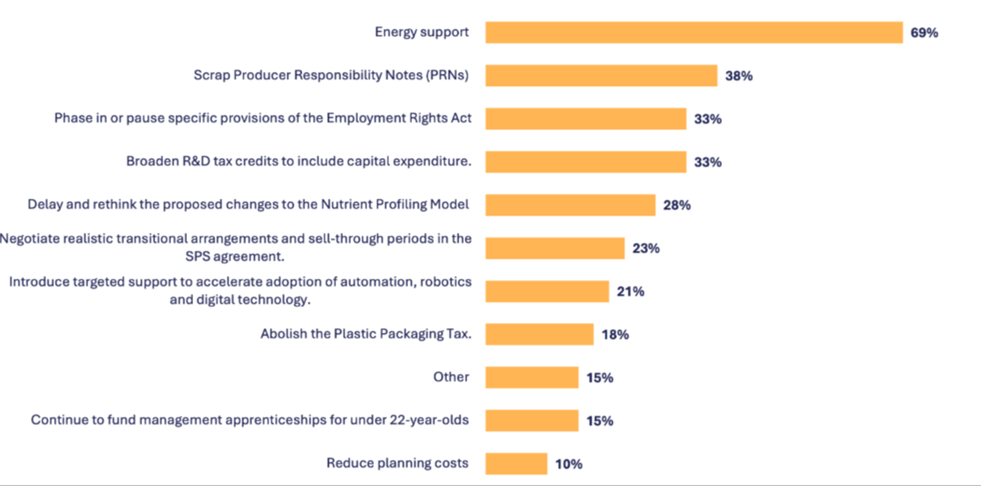
- Two thirds of the industry (69%) says that support with energy costs should be a key priority for government to ease cost pressure, while minimising regulatory burdens, including delaying changes to the Nutrient Profiling Model (28%) and ensuring realistic transition periods for the EU SPS deal (23%) are also industry priorities
Confidence among the UK’s food and drink manufacturers has taken a dive, dropping to -64% in Q1 2026. This is the lowest level seen since the invasion of Ukraine in 2022, and is on a par with the low confidence levels seen at the beginning of the Covid pandemic1 – signalling the severe impact that the war in Iran is having on the UK’s food and drink businesses.
The Food and Drink Federation’s (FDF) latest State of Industry report shows that this is not a short-term impact. The outlook confidence score for the next quarter stands at -51%, with most businesses anticipating conditions will continue to deteriorate into Q2.
The impact of the war in Iran
UK food and drink manufacturers are feeling the impact of global supply chain disruptions, with rising energy prices set to push up production costs. The 2026 Q1 State of Industry shows that, for a fifth of food manufacturers, energy amounts to more than 10% of their total operating costs. For nearly a tenth (8%) of manufacturers, energy makes up as much as 20-24% of their operating costs.
Food and drink manufacturers also highlighted that the cost of plastic packaging has risen by up to 15%, while some reported facing increased transport costs of over 20%.
Further up the supply chain, the increased cost of fertiliser is a concern. The Gulf region is responsible for 30% of the world’s urea production. This, along with increased transport and energy costs, will contribute to the rising price of ingredients. According to the UN FAO, global agricultural prices were 4.1% higher in April, than in February2.
As a result, 82% of food and drink manufacturers have said they will need to increase prices to cover these rising costs. Meanwhile, manufacturers are also expecting to make changes to cut costs where possible. A third are planning to restructure or reduce their headcount (33%), or reduce marketing spend (33%). Over a quarter (26%) are planning to cancel or pause investment projects and a fifth (21%) will need to reduce staff training, hampering the long-term growth and resilience of the sector.
Safeguarding sector resilience
With rising costs across the board having long-term consequences, FDF is calling for government to take steps to address the pressure building on food and drink manufacturers; protect the sector’s resilience and ultimately avoid further food inflation.
Over two thirds (69%) of food manufacturers say support with energy costs should be a top priority for government to help ease the current strain on the sector. Minimising regulatory pressure is also a priority3. In particular:
- 38% are calling for government to simplify packaging recycling reforms
- A third (33%) for a phased introduction of the Employment Right’s Act
- 28% for a delay to changes to the proposals on Nutrient Profiling Model (NPM)
- Nearly a quarter (23%) have said realistic transitional arrangements for the upcoming EU trade deal would help them with current pressure
Karen Betts, Chief Executive, The Food and Drink Federation (FDF), said:
“It’s unsurprising that confidence is low among food and drink manufacturers. Companies in our sector have been hit by a series of shocks over the past five years and now face significantly rising energy and other costs because of the war in Iran. In the last inflation spike, companies made savings to absorb some of their rising costs, but now there’s little flexibility left to do this again. What’s more, government is proving inflexible in its own asks of the sector – they are reluctant to offer energy support to intensive users across food and drink production while they continue to layer on regulatory change.
“Companies are having to change their operations to realign with EU law, cover the huge costs of recycling reforms, work out if they can continue to make food healthier to rapidly shifting government targets, and adapt to new employment law – and piling so many asks on industry at once comes at a cost.
“Food and drink isn’t something people can go without. It’s an everyday essential, and the cost rises caused by energy prices and regulatory costs have consequences in homes everywhere. It also impacts companies’ ability to succeed and grow, and to support the prosperity of whole communities who work in our sites everywhere across the UK. Government needs to work in much better partnership with the food industry to shore up our resilience while helping shoppers manage a maelstrom of rising costs.”
Stabilising food inflation
FDF has forecast that food and drink inflation could reach at least 9% by the end of the year. To minimise the impact on shoppers and help stabilise inflation, FDF is calling for rapid, targeted and time restricted support for energy prices during this crisis, focusing on categories that use the biggest share of energy. This could be modelled on the scheme which was introduced during the Russian invasion of Ukraine.
It’s also vital that government gives businesses breathing room to weather this current storm by minimising additional regulatory pressure and cutting red tape. For example, it should delay the proposed changes to the Nutrient Profiling Model (NPM) until a five-year review of current High Fat, Sugar and Salt (HFSS) advertising and promotion restrictions has taken place. Ensuring realistic transition and sell-through periods to allow businesses time to adapt to the Sanitary and Phytosanitary (SPS) agreement with the EU will also ease the impact of upcoming regulatory change.
Notes to Editors
Read the Q1 State of Industry.
- Businesses confidence was at -72% in Q2 2022, -79% in Q3 2022, and -65% in Q2 2020
- https://www.fao.org/worldfoodsituation/foodpricesindex/en/
-
- FDF Q1 State of Industry:
 About FDF
The Food and Drink Federation (FDF) gives a voice to the food and drink manufacturing industry – the UK’s largest manufacturing sector. We contribute over £42bn to the country's economy, supporting half a million jobs and driving growth at home and abroad. For more information on the FDF and the industry we represent, visit www.fdf.org.uk.
For further enquires please contact the FDF Press Office or contact 020 7420 7140.